Using Hall Sensors with MicroSquirt VR1 Input

This forum is for discussion of MicroSquirt (TM) from Bowling and Grippo. The MicroSquirt information site is at www.usEasyDocs.com
Forum rules
Read the manual to see if your question is answered there before posting. If you have questions about MS1/Extra or MS2/Extra or other non-B&G code configuration or tuning, please post them at http://www.msextra.com The full forum rules are here: Forum Rules, be sure to read them all regularly.
Post Reply
Bruce Bowling
Site Admin
Posts: 285
Joined: Mon Feb 16, 2004 4:25 pm
Location: Baltimore, MD

Using Hall Sensors with MicroSquirt VR1 Input

Post by Bruce Bowling »

There are a few applications where a hall sensor is used as the primary crank sensor. for the primary trigger into MicroSquirt, there is the opto circuit and the VR circuit. For distributor-like applications (i.e. one pulse per cylinder) the opto works well. For multitooth crankwheel arrangements the VR1 input is the preferred choice. The issue here is that the VR1 input is used for zero-crossing waveforms generated by VR sensors. The signal must pass thru zero volts to reset the built-in hysteresis circuit.

To visualize, here is a simulation of a VR sensor triggering the VR circuit:

Image

The green smooth wave is the VR signal and the blue is the VR interface circuit triggering. You can see that the VR input signal must go thru roughly 100 millivolts to cause a trigger, and on the other side the voltage needs to pass thru roughly -50 millivolts.

The problem with using a hall sensor is that the output signal will always be above 0 volts - either near 12 volts (if biased at battery potential) or near 0.7 volts when active. There is no negative voltage to reset the hysteresis. So, what can be done?

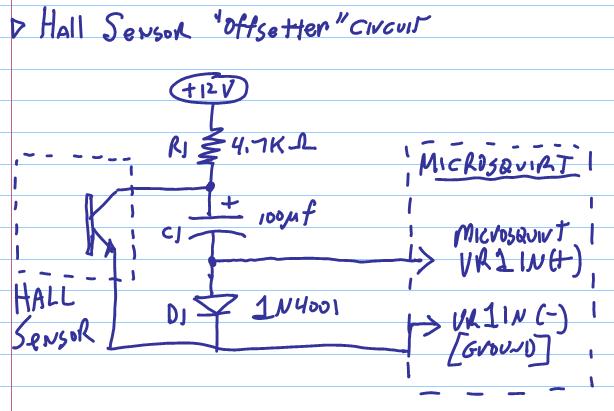
Here is a really simple circuit I call a "Hall Sensor Offsetter", here is the schematic:
Image

It is comprised of three components, a resistor (which may already be there for the hall sensor), a capacitor, and a diode. The capacitor in this circuit is known as a "bootstrap" capacitor, and it is used to generate an offset potential, in this case negative.

Circuit operation is simple. When the hall sensor is not conducting, the bootstrap capacitor C1 charges up thru resistor R1 ad diode D1. The voltage on the top of the capacitor is roughly battery potential when charged. The potential on the bottom of the capacitor is roughly 0.7 volts due to the diode voltage drop - this is fed into the VR1 positive input. So this potential is high enough to trigger the circuit.

When the hall sensor is conducting, the positive side of C1 is pulled to about 1 volt or so due to the transistor turning on (this is the transistor VCE value). In this case the diode D1 is not conducting so it is not in the picture. But, there is still a charge on the bootstrap capacitor acting like a battery. So the potential on the bottom terminal of the capacitor is equal to 1 volt (VCE) minus 11.3 volts (charge on the cap) to give roughly -10.3 or so volts. This is a negative voltage, enough to trip the hysteresis circuit.

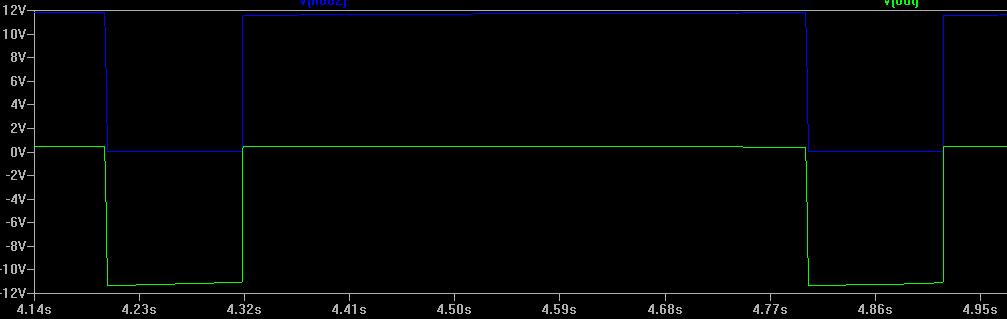
Here is a simulation of the circuit:
Image

The blue waveform is the voltage on the collector of the hall sensor, and the green is the negative bootstrap capacitor (to VR1+). The voltage translation or offset is apparent on the green trace, enough to trigger the VR1 input easily. Also, there is no phase shift, just a voltage translation which is very important for accurate timing.

Finally, this circuit is for the VR1 input. The VR2 input in MicroSquirt, used most often for cam sync, is already biased to trigger at a higher value (roughly 1.8V) so it is ready for a hall sensor.

- Bruce
dontz125
Master Squirter
Posts: 375
Joined: Mon Jun 29, 2009 1:00 pm
Contact:

Re: Using Hall Sensors with MicroSquirt VR1 Input

Post by dontz125 »

Wow - serious thread necromancy!

Two questions about the bootstrap cap. First, does the value matter? This isn't driving a high-power high-speed high gate charge MOSFET, but rather a little SOT23 MMBT2907 - and through some hefty series resistance at that. 100uF caps are big and rather spendy; if a 1.0uF 0805 MLCC cap can do the job, so much the better.

Second, if the value does need to be that large, is there a chance that the voltage polarity can cause upsets? The only caps that big are aluminum and tants, neither of which appreciates facing backwards!
bbbrad
MegaSquirt Newbie
Posts: 6
Joined: Tue Mar 03, 2015 12:09 am
Location: new zealand

Re: Using Hall Sensors with MicroSquirt VR1 Input

Post by bbbrad »

Hi, this is my first post. I hope thats ok. I have a couple of questions relating to the above. is there an easy way to tell if my hall sensor already has a built in pullup resistor? Also is the above mod required in all cases? or just some? The is no mention of this problem/solution in the....
http://www.msextra.com/doc/pdf/html/Mic ... e-3.3.html

Im only new to this but just trying to get my head around it all. I have a dsm 6g75 with a very nice built in factory crank hall setup. Id like the simplest setup possible and am trying to decide between a vr or hall.
24c
Master Squirter
Posts: 593
Joined: Sat Feb 16, 2008 12:15 pm
Location: Chorley, Lancashire UK
Contact:

Re: Using Hall Sensors with MicroSquirt VR1 Input

Post by 24c »

So what Microsquirt have you bought, is it secondhand, a module board or the newer plastic cased v3?
bbbrad
MegaSquirt Newbie
Posts: 6
Joined: Tue Mar 03, 2015 12:09 am
Location: new zealand

Re: Using Hall Sensors with MicroSquirt VR1 Input

Post by bbbrad »

I will be using the microsquirt v3. Cop in wasted spark. Crank wheel only setup.
dontz125
Master Squirter
Posts: 375
Joined: Mon Jun 29, 2009 1:00 pm
Contact:

Re: Using Hall Sensors with MicroSquirt VR1 Input

Post by dontz125 »

In that case you'll want to use the wiring arrangement on p.50 (no internal pull-up) or p.51 (internal pull-up).

The only way to tell if yours has an internal pull-up is to actually try it. If you can identify the sensor, you can look up the datasheet and see what it says.
bbbrad
MegaSquirt Newbie
Posts: 6
Joined: Tue Mar 03, 2015 12:09 am
Location: new zealand

Re: Using Hall Sensors with MicroSquirt VR1 Input

Post by bbbrad »

Thanks alot for your advice.
Post Reply